Consultation over for proposed consolidation
Date: December 23, 2025
Thank you for your support of local conservation
The Province of Ontario's consultation on proposed consolidation of conservation authorities has now ended. Ausable Bayfield Conservation would like to thank everyone who expressed their support for local conservation in their watershed.
Date: December 16, 2025
Please comment to the ERO, re: proposed consolidation of conservation authorities
The deadline to provide input is Monday, December 22, 2025
Ausable Bayfield Conservation Authority (ABCA) has submitted comments, to the Environmental Registry of Ontario (ERO), about proposed consolidation of local conservation authorities into larger regions.
Key highlights of the submission are:
- Strong, local municipal governance and oversight is fundamental to effectively deliver the vital watershed management programs and services that protect communities from natural hazards.
- The Huron-Superior boundary is untenable.
- ABCA does not support the proposed boundary configuration.
- ABCA encourages the Province of Ontario to modernize and support conservation authorities within current watershed-based boundaries and governance.
- To maintain, and strengthen local relations and community trust, conservation authority boundaries must reflect local landscapes and economic drivers.
Our concerns are related to the importance of local delivery of conservation services and were prepared to meet the ERO’s prescribed format.
The following are some concerns and considerations:
Local Governance
- Challenges such as flooding, erosion and water quality issues are the result of many upstream activities (even some which might seem insignificant on their own) on the landscape. Maintaining local governance helps ensure preventative measures and management are shared across the watershed.
- As local organizations, conservation authorities are responsive to community needs. If conservation authorities are consolidated into seven regional agencies, this would mean less municipal input on service priorities.
- How will the needs of rural communities and the agricultural sector be adequately recognized and prioritized in consolidation, particularly since the lead conservation authority is expected to be an urban one in each region?
Cost
- Member municipalities provide the lion’s share of the operating budget for conservation authorities. Across all conservation authorities the Province of Ontario provides about five per cent of funding. A renewed partnership needs to include the Province providing a greater share of funding as they did in the 1980s and early 1990s.
- The Ontario Provincial Conservation Agency (OPCA) will require resources while local watershed advisory boards would still be needed to guide priorities and provide oversight.
- The Province of Ontario has not developed a business case to support the proposed changes. How do they know whether these changes will improve services and create efficiencies if they have not undertaken any analysis of the costs and the benefits?
- What is the cost of consolidation? Who will pay for these costs?
Efficiency versus Efficacy
- Conservation authority staff work closely with landowners to identify safe building locations outside hazardous areas. The OPCA will establish provincewide service delivery standards. Will the proposed digital permitting platform be able to match our turnaround times and maintain our high level of customer experience? The average time for reviewing and issuing permits by all conservation authorities is 12.5 business days on average. Additionally, what will the costs be for developing and maintaining this platform? Furthermore, there may be efficiencies in getting permits, but we all pay the cost of unintended consequences of development that is not safe from natural hazards.
- Local watershed management organizations are a made-in-Ontario solution for conservation and public safety. This approach to environmental management is recognized globally for its effectiveness and efficiency.
Please encourage the provincial government to work collaboratively with conservation authorities to build capacity and support local solutions to restore the health of watersheds in Ontario.
Date: December 11, 2025
Ausable Bayfield Conservation Authority (ABCA) approves submission to Environmental Registry of Ontario (ERO) re: 025-1257 proposal for regional consolidation of conservation authorities
- Read the ABCA Submission to Environmental Registry of Ontario re: Ontario proposal 025-1257 to consolidate conservation authorities into regions – 300 KB (medium-sized) PDF file
The submission, in part, says:
" ... The Ausable Bayfield Conservation Authority affirms that strong, local municipal governance and oversight is fundamental to effectively deliver the vital watershed management programs and services that protect communities from natural hazards. As currently proposed, the Huron-Superior boundary is untenable. The ABCA does not support the proposed boundary configuration as outline in ERO 025-1257 and encourages the Province to modernize and support conservation authorities within current watershed-based boundaries and governance. To maintain, and strengthen local relations and community trust, conservation authority boundaries must reflect local landscapes and economic drivers ...""
Read more about the ABCA response to the proposed changes:
Date: November 28, 2025
Ausable Bayfield Conservation Authority (ABCA) board approves letter, resolution in response to Ontario’s proposed consolidation of conservation authorities
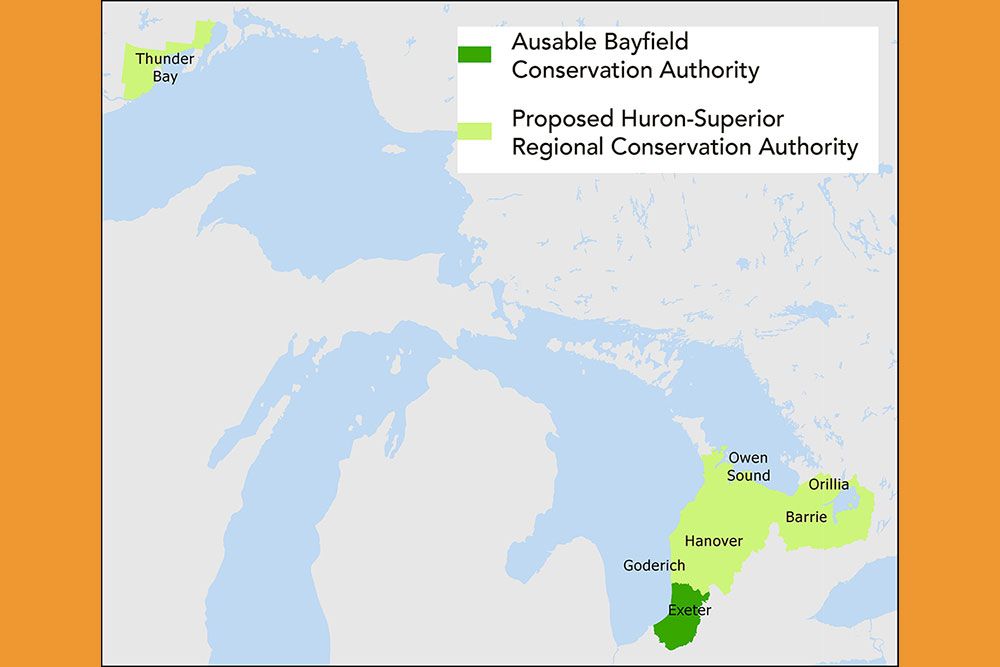
ABCA Board of Directors approves motion defending local watershed management, advising against provincial proposal which would create regional conservation authority stretching from Grand Bend to Thunder Bay
The Ausable Bayfield Conservation Authority (ABCA) Board of Directors approved a letter and motion responding to the Province of Ontario’s proposals which would create larger, regional conservation authorities. The board approved the resolution at its meeting on November 20, 2025.
You may read the letter here:
- Resolution #80-25, by the ABCA Board of Directors, in response to Bill 68 – Proposed New Ontario Provincial Conservation Agency and ERO #025-1257 – 300 KB (medium-sized) PDF file
The ABCA board resolved it does not support the Province’s proposed large, regional Huron-Superior Regional Conservation Authority. That amalgamated body would include 80 municipalities and merge seven conservation authorities located as far away as Thunder Bay (Lakehead Region) with Ausable Bayfield; Maitland Valley; Saugeen Valley; Grey Sauble; Nottawasaga Valley; and Lake Simcoe conservation authorities.
A proposed regional watershed would create a “ … geographically vast and administratively complex organization when joining northern municipalities with those that are rural such as ABCA, where agriculture is the main economic driver,” the resolution said. The loss of local knowledge and community relationships would add “ … uncertainty, loss of trust, and delay for our watershed residents.” Local governance and direction combined with local service delivery allows ABCA to “ … continue to be responsive to our community,” the motion read.
A move away from local conservation authorities is “ … contrary to the basic principle that decisions are best made closest to the communities they affect,” the resolution said. It asks the Ontario Ministry of the Environment, Conservation and Parks to engage directly with affected municipalities and conservation authorities in a working group before finalizing any proposed consolidation of boundaries.
ABCA Chair Ray Chartrand said, in the letter accompanying the resolution, that ABCA supports the Province’s “... desired outcome of improved consistency and modernized digital permitting processes, aligned with its goals and objectives for cutting red tape and getting more homes built faster, and safely.” He said, however, that instead of proposed large-scale regional consolidation, ABCA encourages the Province to achieve its goals by building on “ … the proven strengths and relationships of local conservation authorities and their umbrella organization, Conservation Ontario.”
The ABCA board said it encourages municipalities and other community partners to review the ‘Proposed boundaries for the regional consolidation of Ontario’s conservation authorities,’ a proposal (number 025-1257) posted on the Environmental Registry of Ontario (ERO).
The board also encouraged the community to submit comments well in advance of the Province’s consultation closing date of December 22, 2025. The ABCA circulated the Chair’s letter and the board’s resolution to the government and a number of other recipients.
The ABCA board will also submit its input to the Province through the current consultation
Issue Date: November 3, 2025
Ausable Bayfield Conservation Authority will follow closely Ontario’s proposed changes affecting local watershed management and conservation authorities
Public has chance (until December 22, 2025) to review and comment on proposed changes on Environmental Registry of Ontario; Proposal includes plan for new Ontario Provincial Conservation Agency (OPCA) and ‘regional, watershed-based consolidation of conservation authorities’
Ausable Bayfield Conservation Authority (ABCA) is following closely proposed changes, announced by the Province of Ontario, that would affect conservation authorities and local watershed management. Proposed changes include a provincial plan for a new Ontario Provincial Conservation Agency (OPCA) and “ ... regional, watershed-based consolidation of conservation authorities.”
The Ontario Ministry of the Environment, Conservation and Parks (MECP) announced, on October 31, 2025, that Ontario plans to create a new conservation authority agency “ ... to improve service delivery and protect communities.”
The Province of Ontario news release is online at news.ontario.ca.
Todd McCarthy, Minister of the Environment, Conservation and Parks, and Hassaan Basit, Chief Conservation Executive, held a press conference, about the proposed changes, on October 31, 2025. The live-streamed video is on the Government of Ontario Announcements channel on YouTube.
Ray Chartrand is Chair of the ABCA Board of Directors. He said the local conservation authority is reviewing the Minister’s announcement. The Board, representing 12 member municipalities, will hold a special meeting to discuss the Province’s proposal.
ABCA will also work with Conservation Ontario, which represents Ontario’s conservation authorities, in the coming weeks to provide input into the proposed changes.
The public, local municipalities, and other stakeholders will have a chance to review and comment upon Ontario’s proposal following posting on the Environmental Registry of Ontario. There is a 45-day consultation period, ending December 22, 2025, on the changes.
For Ontario's proposed boundaries for the regional consolidation of Ontario’s conservation authorities please visit the Environmental Registry of Ontario (Policy 025-1257).
The proposal was posted on Friday, November 7, 2025 and the 45-day comment period lasts until Monday, December 22, 2025.
“The Province has said they look forward to input on their proposal. That is encouraging,” Chartrand said. “We hope people provide input to the government and that the government listens to that input. We appreciate that the Province of Ontario continues to recognize the need for conservation authorities to deliver the programs and services that we deliver today. The Province wants conservation authorities to continue our mandate. That mandate is to continue to protect Ontarians from natural hazards such as flooding and erosion, to protect municipal sources of drinking water, and to manage conservation lands, trails and recreational and educational facilities.” It is also encouraging the Province has said any approved changes will not reduce staffing levels, he said.
Ausable Bayfield Conservation Authority supports continued close work with the Province to streamline approvals and response times and to deliver services efficiently, Chartrand said. At the same time, he said changes need to be practical. The work of conservation authorities needs to continue to be science-based and continue to be based on management of resources at the local watershed level. Conservation authorities also need to continue to be locally responsive to maintain the relationships and partnerships that benefit our communities here in rural Ontario today, he said.