Partnerships support species recovery in Ausable
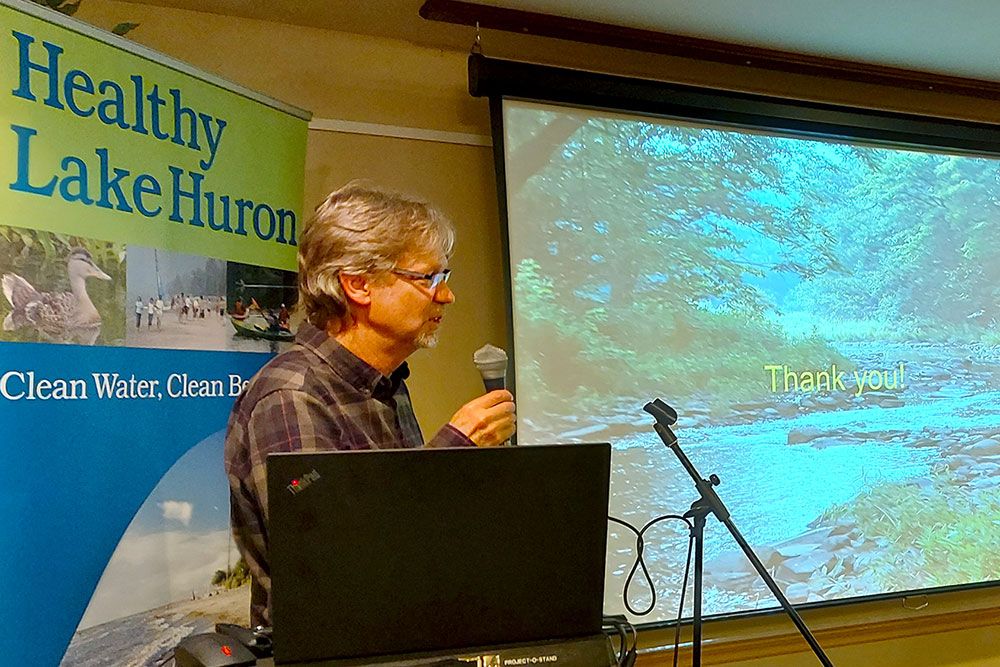
Partnerships in Ausable River watershed help to monitor, support recovery of fish, mussel species, biologist says
Ausable River watershed is nationally important as home to aquatic species at risk; Monitoring, education and stewardship support recovery of these species, biologist tells Ausable Bayfield Conservation’s Partner Appreciation Evening
The Ausable River is “ ... one of the richest watersheds of its size for freshwater biodiversity,” according to Shawn Staton, Team Leader for Ontario with the Species at Risk Program of Fisheries and Oceans Canada. He spoke on Aquatic Species at Risk Recovery in the Ausable River Watershed: The Power of Partnerships at Ausable Bayfield Conservation’s Partner Appreciation Evening. More than 110 people attended the event at Ironwood Golf Club on Thursday, March 26, 2026.
There are 85 species of fish in the Ausable River and seven of those are species at risk.
There are 27 species of freshwater mussels in the Ausable River and eight are species at risk.
The Ausable River is nationally important as a home to species at risk. It has “... globally rare ...” mussel species and is home to some species that are almost extinct. Populations of some native freshwater mussel species in the Great Lakes have been wiped out by the invasive Zebra Mussel. Rivers like the Ausable River may be “ ... the last refuge,” for some aquatic species, the speaker said.
Two thirds of mussel species in Ontario are found in the Ausable River. There are 41 different species of mussels in Ontario. “One of the cool things about them is the diversity in shapes, sizes, and colours,” the speaker said.” Ontario’s mussels have very interesting and colourful names, he said. Those names include Threehorn Wartyback; Threeridge; Purple Wartyback; Northern Riffleshell; Deertoe; Elktoe; Kidneyshell; and Snuffbox.
“Another cool thing about mussels, that most people don’t realize, is they’re really dependent on the fish community,” he said. Mussels have a unique life cycle as they are parasitic on fish during their larval stage. Young mussels attach to the gills of appropriate fish hosts taking in nourishment for a period of time before they drop off to become free-living.
Mussels filter and clean the water in the river and remove suspended sediment. “They can have a real measurable impact on water clarity, just to give you an idea of some of the ecosystem benefits you can get from mussels.” One mussel can filter up to 40 litres of water per day.
Species listed under the Species at Risk Act (SARA), may be special concern, threatened, endangered, or extirpated. Ontario, which includes southwestern Ontario and the Carolinian Zone, has the highest number of species at risk in Canada. In Ontario, there are 29 fishes listed under SARA and 15 freshwater mussel species.
Shawn has helped to develop recovery strategies to identify ways to help with recovery of some of these species. At Fisheries and Oceans Canada, the biologist has worked since 2003 to identify critical habitat for aquatic species at risk.
Preparation and implementation of action plans, supported by funding programs, helps with species recovery. Canada’s Habitat Stewardship Program for Species at Risk and the Canada Nature Fund for Aquatic Species at Risk have provided funding support for stewardship projects in the Ausable River watershed.
The presenter was part of the creation of the former Ausable River Recovery Strategy and the current Ausable River Action Plan. The action plan identifies critical habitat for aquatic species to provide context for recovery actions. Plan actions have been implemented to address threats. These actions include reducing sediment and nutrient loading through best management practices and stewardship projects. Enhancements have included riparian buffers, erosion control, conservation tillage, cover crops, berms, livestock fencing, manure storage and runoff collection systems, and re-establishing wetlands across the watershed.
The speaker praised Ausable Bayfield Conservation staff for their role in environmental monitoring of aquatic species and in their work with participating landowners to implement stewardship projects on the ground from 2004 to present.
The slide show documented hundreds of local projects over the years to protect and enhance habitat for aquatic species in the Ausable River watershed. These projects included restoration of hundreds of hectares of land and a quarter of a million trees planted, thousands of acres of cover crops planted, and buffers established stretching the equivalent length of 38 kilometres.
The presenter also shared the education and outreach conducted in the Ausable River watershed including more than 60 events for watershed landowners, where they learned about species at risk, habitat, threats, and actions to protect these species. There were also more than 300 classroom education activities. More than 7,000 students learned about aquatic species and protecting them. “That’s pretty impressive,” the speaker said. It was great, he said, for these young people to learn about these species at risk, what’s going on in the river, the significance of the river, and the biodiversity. It was also valuable, he said, that they may bring that message home to their parents and guardians.
Assisted by Fisheries and Oceans Canada funding, Ausable Bayfield Conservation staff have worked with landowners and other community partners to implement projects, since 2004. Staff members have also implemented a watershed-wide mussel monitoring program. The results of the mussel monitoring represent “ … encouraging evidence of a healthy mussel community with increasing densities at most sites,” the guest speaker said. Federal funding supported environmental monitoring of aquatic species in the Ausable River, with sampling at more than 300 fish sites and 50 mussel sites.
Long-term monitoring of mussel populations provides important data on “ ... density for individual species as well as demographics of the population, so we can really tell how healthy the populations are, how much reproduction is going on if it is going on.” This data informs not only how conditions are changing in the river but also support national status assessments for individual species over larger areas. “It’s very important,” he said. Mussel monitoring requires a high level of expertise and he said the expertise of staff experts at ABCA, including aquatic biologist Kari Jean, is highly regarded.
It’s exciting to see increased density of some mussel populations in the Ausable River, he said, although this is not the case at all sites. “The mussels appear to be responding to improving habitat conditions so this is what we’re really excited about,” the speaker said. “We want to continue the long-term monitoring program and investigate the reasons for the declines (at one site).”
Funding and strong partnerships are essential, he said, for effective species-at-risk stewardship and recovery actions. Ausable Bayfield Conservation’s Ausable River recovery program “ ... is an outstanding example of the power of partnerships.” Fisheries and Oceans Canada could not accomplish everything that has been accomplished, in the Ausable River Watershed, without the work of the conservation authority, local landowners, and other community partners, Staton said. “It really takes a collaborative approach and I’ve been so impressed by the passion and commitment of ABCA biologists.” Fisheries and Oceans Canada appreciates the work of the conservation authority staff in Ausable Bayfield watersheds, he said, and “ ... so do the species.”
The speaker recounted how he became interested in freshwater mussels. Originally he wanted to research fish but his interest in mussels grew as he got a job where he was doing mussel population surveys that hadn’t been done in many years. He initially worked on mussel surveys in the Sydenham, Thames and Grand rivers. “I became a huge mussel fan,” he recalled. He learned to identify the different mussels and he helped to prepare status reports on mussel species at risk. The model of mussel surveying used in the Sydenham River was later applied to the Ausable River.
Shawn Staton is co-author of the Action Plan for the Ausable River: An Ecosystem Approach (written along with ABCA’s Kari Jean and Mari Veliz). The document outlines detailed steps to protect populations of the Northern Riffleshell; Snuffbox; Kidneyshell; Lake Chubsucker; Pugnose Shiner; and Eastern Sand Darter in the Ausable River watershed. The Ausable River Action Plan is available on the Government of Canada’s Canada.ca website.